

Lighting and Layout: Desks That Don't Fight the Windows
Most offices are planned from a drawing, and a drawing has no windows in it. So the desks go where the room is widest, the screens end up facing the glass, and by ten o'clock on a bright morning half the team is squinting and the other half is a silhouette on a video call. Office desk placement is not really about the furniture. It is about the light you already have, and working with it rather than against it.
I spent years in hotels where a badly placed table cost you a table. The office version is the same lesson at a desk. Here is the plan I use.
Two problems, one cause
Glare and backlighting are the same window seen from two sides. Face the window and the light hits your screen and your eyes. Turn your back to it and the light hits the camera instead, so everyone on the call sees a dark shape against a bright sky. The desk that solves both is the one that sits side-on to the glass, so the window is on your left or right, the screen is at right angles to it, and daylight lands on the work without landing on the screen.
Put the window on your shoulder, not in front of you and not behind you. Everything else in the room follows from that.
Planning a desk run around the light
1. Walk the room at the wrong time of day
Visit at nine and again at three. South and west facing rooms change completely between the two. A run that looks fine at lunchtime can be unusable by mid afternoon, and the person who sits there will tell you, eventually, by moving.
2. Run the desks off the window wall
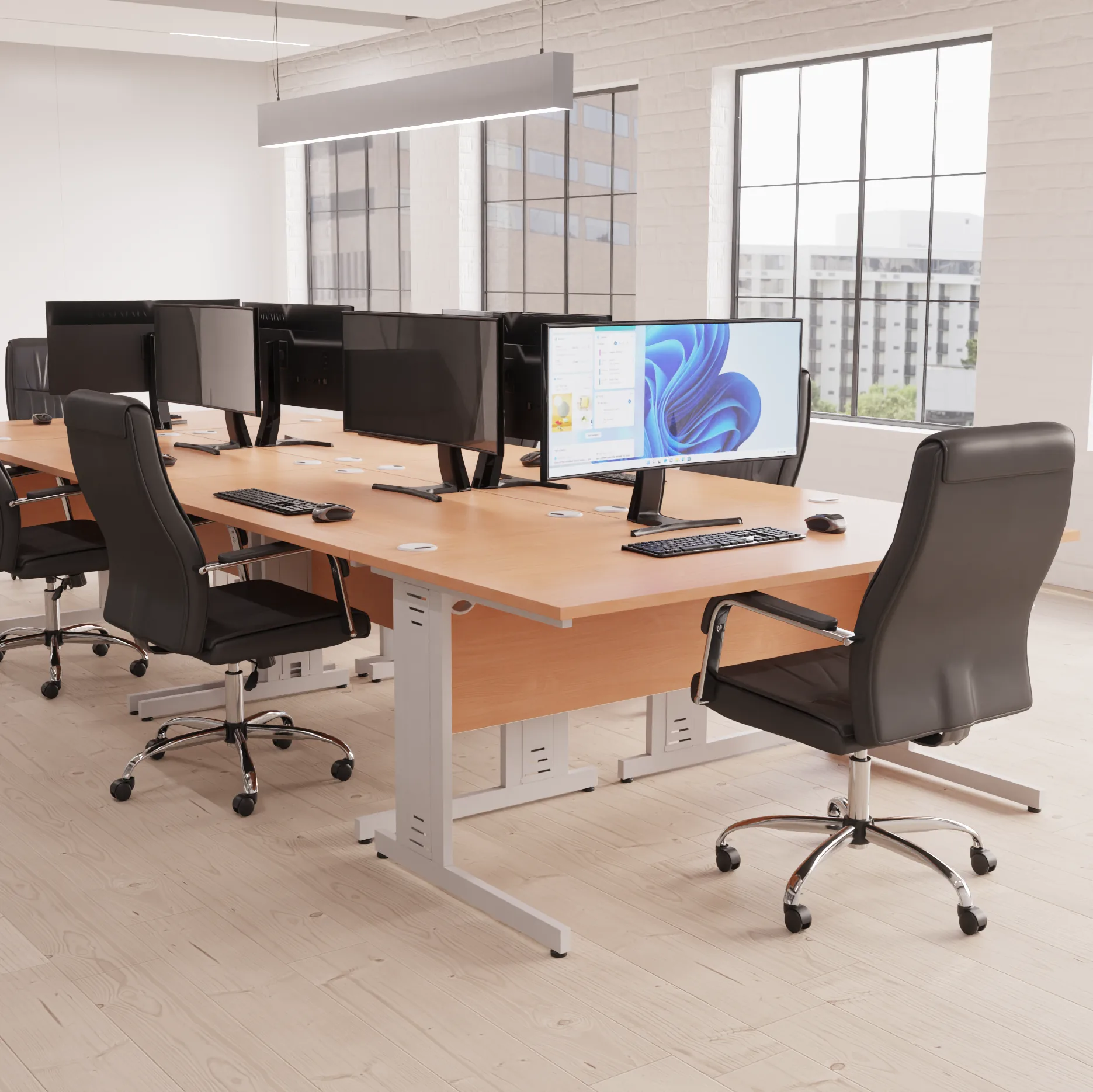
Straight desks placed end to end, running away from the window at right angles, give every seat the light on one shoulder. It is the classic school-room layout for a reason. A straight rectangular desk at 140 or 160cm wide is the easy building block, and because they are all the same depth the run stays tidy however many you add.
3. Benches want the window at the end
A back-to-back bench desk puts two people facing each other, so somebody always has their back to something. Point the long axis at the window and both rows get side light. Point it across the window and one row is squinting while the other is backlit. The bench is the same product either way. Only the direction changes.
4. Keep the deep-room seats for the screens that matter
The desks furthest from the glass get the steadiest light all day. That is where design work, spreadsheets and anyone who lives on video calls should sit. Save the window seats for people who are up and down and do not mind the change.
Where the top finish comes in
A white desk under a bright window bounces a lot of light back up at you. It photographs beautifully and it is lovely in a north-facing room, but in direct sun it becomes a second light source. A mid tone like oak or beech takes the edge off without making the room dim, which is why so many of the runs we see near big windows end up on oak office desks or something close to them. Dark tops go the other way and show every fingerprint in sunlight, so I only suggest them for rooms with soft light.
When you cannot move the desks
Some rooms only work one way round. If a desk has to face a window, a low screen or divider between the desk and the glass takes the worst of it without blocking the view, and our desk screens and dividers are made for exactly that. If a desk has to sit with its back to the window, a lamp on the desk lifts the face for calls, and a blind you can half close does more than any camera setting.
And if you would rather someone looked at the room with you before you order, that is part of what we do. Send us the measurements and a photo taken from the door, tell us which way the windows face, and we will help you get it right first time. It is the same desk either way. It is just a better morning.
Contents

Customer Experience Manager
Makes sure every order feels handled by a person, not a portal.